Dry Grinding Mill — For Powders That Never See a Solvent
Dry milling competes with wet milling on cost, and usually loses. It wins on one thing: you get powder out, not slurry. If you need powder, wet milling means you are paying for a dryer you did not want.
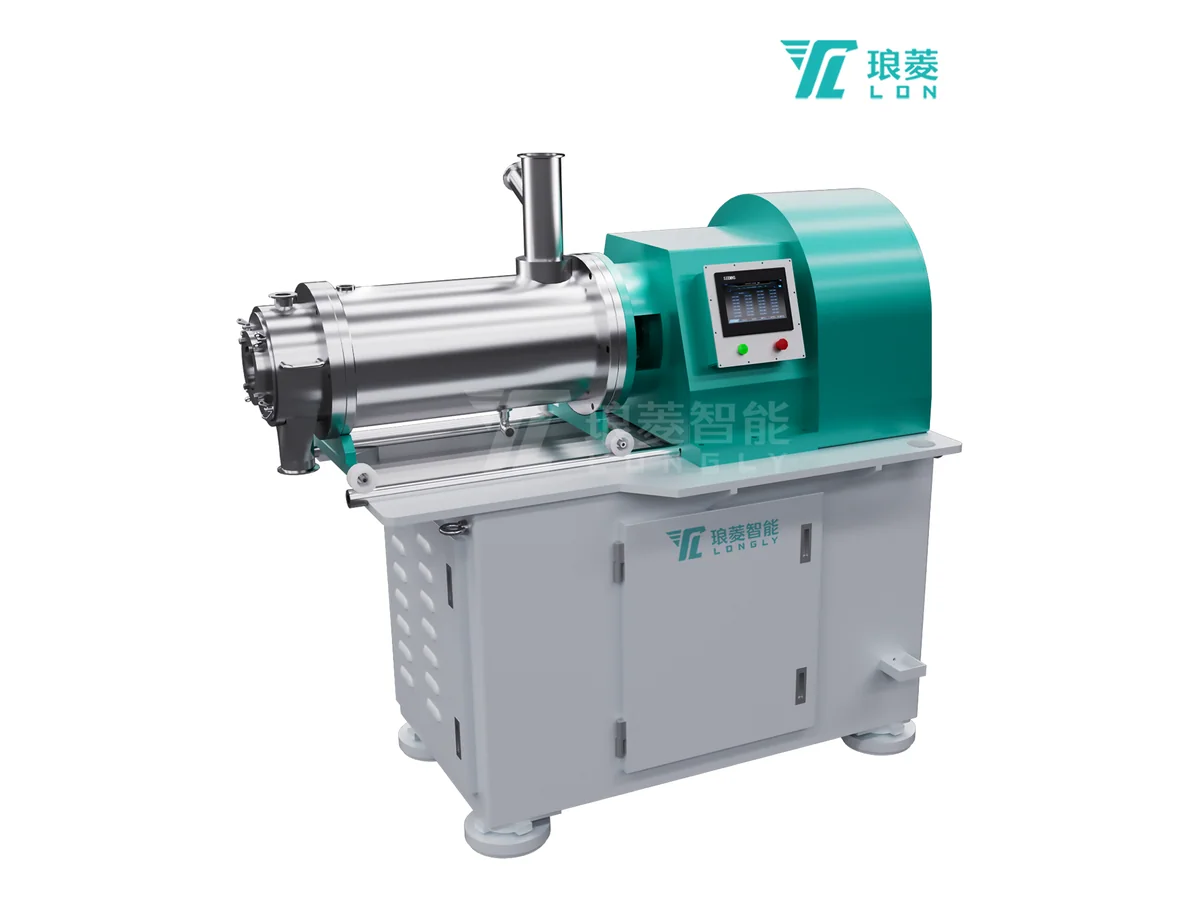
A mill and a classifier in one loop
Material is fed dry into a stirred chamber. An air stream carries fines out through a classifier wheel and returns coarse particles to the chamber. The classifier is not an accessory — it is what makes the size distribution narrow enough to sell.
Everything downstream is dust handling: cyclone, filter, and a rotary valve that actually seals. Budget for that as part of the machine, not as an afterthought.
Wet or dry — the only test that matters
Do not choose dry because it sounds simpler. Choose it because the next step in your process requires powder. Everything else favours wet.
| PM-D dry | PM-N / PM-M wet | |
|---|---|---|
| Output form | Powder, directly | Slurry — needs drying if you sell powder |
| Energy per tonne | Higher, plus the air system | Lower |
| Media wear | Higher — dry beads abrade faster | Lower |
| Dust and containment | Significant. Filters, ATEX thinking, operator exposure | Minimal |
| Tightest fineness | D90 2 – 5 µm with classification | Sub-100 nm is routine |
| Thermal damage | Harder to remove heat — no liquid to carry it | Water jacket does the work |
| Best for | Solvent-sensitive, reactive, or powder-sold products | Everything you can wet |
Rule: if you can wet-mill it and you are happy to dry it, wet-mill it. Dry milling is for materials where the liquid itself is the problem — moisture-sensitive, solvent-reactive, or where a drying step would damage the product.
When dry is the only workable route
Moisture-sensitive product
Cement additives, some ceramics and hygroscopic salts cannot be dried back down without changing the product. If the water cannot leave, it must never go in.
Solvent would be a hazard
Reactive metals, some energetics and certain pharmaceutical intermediates rule out a liquid carrier entirely. Dry is not a preference here, it is a constraint.
You sell powder, not slurry
If the customer wants a bag, wet milling plus spray drying can still be cheaper at scale — but below a certain tonnage the dryer never pays back, and dry milling does.
Solids loading is already extreme
Past roughly 70 % solids the slurry stops behaving like a liquid. At that point you are not really wet milling anyway, and dry becomes the honest description.
PM-D series
| Model | Motor power | Air volume | Media | Target fineness | Classifier |
|---|---|---|---|---|---|
| PM-D30 | 30 kW | 1 200 m³/h | 2 – 5 mm | D90 10 – 45 µm | Dynamic wheel |
| PM-D55 | 55 kW | 2 000 m³/h | 2 – 4 mm | D90 5 – 25 µm | Dynamic wheel |
| PM-D90 | 90 kW | 3 500 m³/h | 1.5 – 3 mm | D90 2 – 15 µm | Dynamic wheel |
Model figures are typical for this configuration — the binding specification comes with your quotation. Air volume matters as much as motor power here — undersizing it is the most common cause of a dry mill that "will not reach fineness".
What we need to size a dry mill
| What | Why it changes the answer |
|---|---|
| Feed D50 and target D50/D90 | Sets media size, air volume and number of passes |
| Throughput, kg/h | Sizes the whole system, not just the chamber |
| Bulk density and flowability | Decides whether the feed system needs a screw or a rotary valve |
| Moisture content of feed | Above ~2 % the classifier blinds and nothing works |
| Explosive dust class (Kst) | Changes the whole electrical and venting specification |
The Kst question is not optional. If your dust is combustible, the mill, the filter and the ducting all change. Sending us the Kst value — or telling us it has never been tested — is the single most useful thing you can do before asking for a price.