Micron and Sub-Micron Bead Mill — the Production Workhorse
Disc or pin? Screen or gap separator? Those two choices decide your throughput far more than motor power does. This page is how we pick between them.
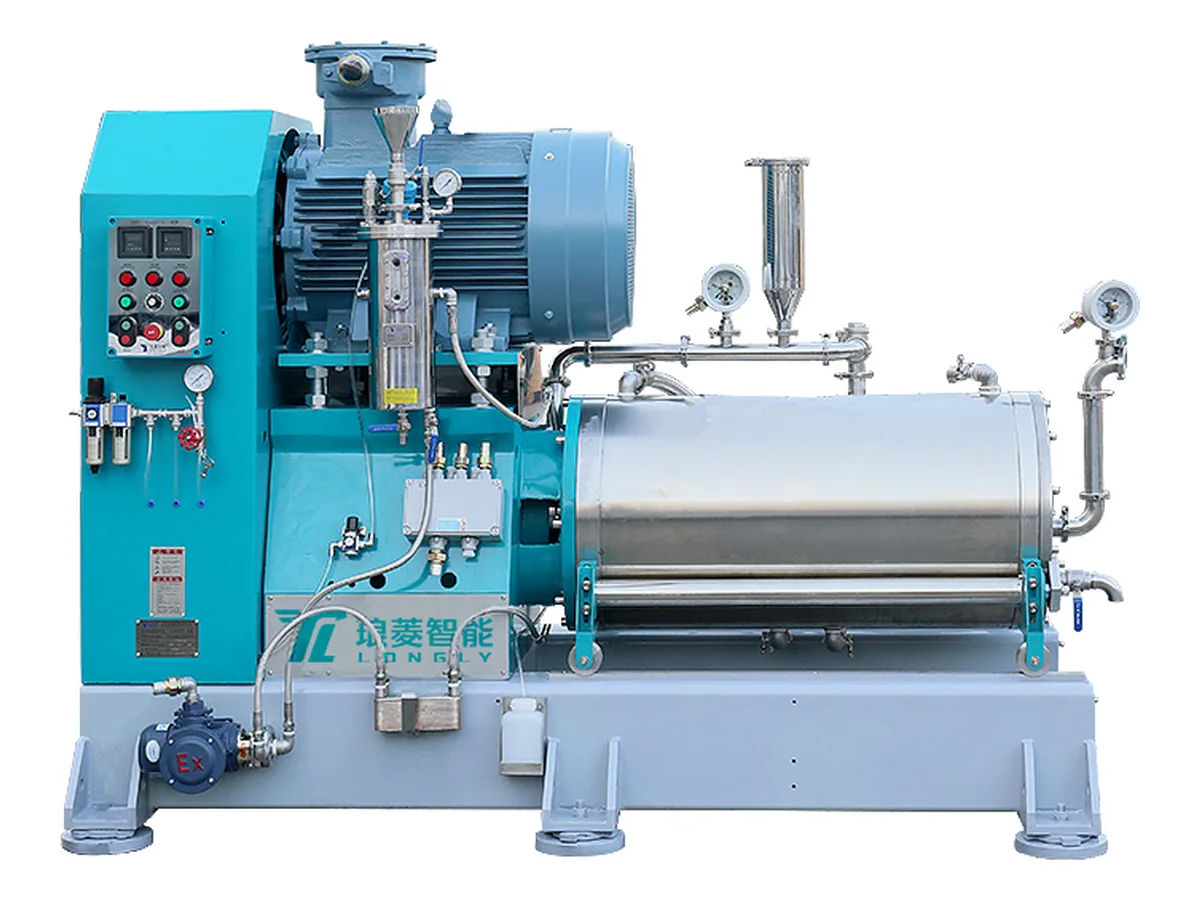
What we actually supply
A continuous horizontal stirred media mill sized for production, running 0.6 to 1.4 mm media and holding D90 somewhere between 1 and 15 µm depending on how hard you push it.
Three sub-configurations — the differences are in the agitator and the separator, not the motor:
Disc or pin — this is the choice most people get wrong
Both are stirred media mills. They differ in how energy gets into the beads, and that difference shows up in your media life and your product temperature.
| PM-MD disc | PM-MP pin | |
|---|---|---|
| How energy is transferred | Beads are dragged by the flat faces of the discs | Beads are sheared between pins — more contact points |
| Energy per unit volume | Moderate | Higher |
| Typical media | 0.8 – 1.4 mm | 0.6 – 1.0 mm |
| Heat generated | Lower — easier to cool | Higher — cooling capacity matters |
| Media wear | Lower | Higher, especially at high tip speed |
| Best for | General coatings, inks, fillers — most plants | Harder agglomerates, carbon black, higher energy demand |
| The trade-off | Slower to reach a given fineness | Faster, but you pay in heat and media |
Rule of thumb: start with discs. Move to pins only if your material genuinely will not reach target in a reasonable number of passes — pins buy you energy, and you pay for it in cooling and media consumption every day.
PM-M series
| Model | Chamber volume | Motor power | Media range | Throughput | Target fineness |
|---|---|---|---|---|---|
| PM-MD30 | 30 L | 22 kW | 0.8 – 1.4 mm | 100 – 400 L/h | D90 5 – 15 µm |
| PM-MD60 | 60 L | 37 kW | 0.8 – 1.4 mm | 200 – 700 L/h | D90 5 – 15 µm |
| PM-MP60 | 60 L | 45 kW | 0.6 – 1.0 mm | 150 – 550 L/h | D90 1 – 5 µm |
| PM-MP150 | 150 L | 90 kW | 0.6 – 1.0 mm | 400 – 1500 L/h | D90 1 – 5 µm |
| PM-MH300 | 300 L | 160 kW | 0.8 – 1.6 mm | 800 – 2500 L/h | D90 5 – 20 µm |
Model figures are typical for this configuration — the binding specification comes with your quotation. Throughput depends more on your slurry than on the chamber — treat it as a starting point and confirm it against a test on your own material.
Common to all models
- Wetted materials: SS316L / hardened steel / polyurethane / silicon carbide
- Separator: screen, gap or centrifugal — see below
- Cooling: jacketed chamber, chilled water, 5 – 35 °C
- Seal: double mechanical seal with barrier fluid
- Control: PLC + HMI, recipe storage, temperature and pressure interlocks
- Options: ATEX / explosion-proof for solvent-based systems
Separator: the part that actually stops production
Ask anyone running a bead mill what stops the line, and it is usually the separator, not the grinding.
| Separator | How it works | Media it handles | Choose it when |
|---|---|---|---|
| Screen | A slotted screen retains media | ≥ 0.8 mm | Simple, cheap, larger media — easiest to service |
| Gap | A narrow annular gap, no screen | 0.3 – 0.8 mm | Finer media where a screen would blind |
| Centrifugal | Media is thrown outward, product exits at the axis | down to 0.05 mm | Nano work, or media that fractures easily |
Blinding is the failure mode to design against. If your media is close to the screen slot width, the screen will block within minutes — and it always happens mid-shift, not during commissioning. If you are running below 0.8 mm media, specify a gap or centrifugal separator from the start.
Horizontal or vertical?
| Horizontal (PM-M) | Vertical | |
|---|---|---|
| Media distribution | Even along the chamber | Tends to settle toward the bottom |
| Sealing | Easier — seal is above the product | Seal runs in product; more wear |
| Floor space | More | Less |
| Best for | Continuous production, high throughput | Small batches, frequent changeovers |
For continuous production at volume, horizontal wins on almost every count. Vertical earns its place when you change formulations several times a day and cleaning time dominates.
Where the throughput actually comes from
Six things, in rough order of impact — and the first one is not the mill:
- Pre-dispersion — a high-shear disperser doing the rough work roughly halves the load on the mill. This is usually the cheapest throughput increase available.
- Media size — larger media moves more product per pass but reaches a coarser floor.
- Tip speed — 8 – 15 m/s typical. More speed, more energy, more heat.
- Media fill — 70 – 85% of chamber volume.
- Number of passes — recirculation gives a tighter distribution than single-pass.
- Temperature — hot product is thin product; it transfers energy differently.
FAQ
Do I need pin type?
Only if discs will not reach your target in a sensible number of passes. Pins cost you cooling capacity and media life — do not buy them speculatively.
Can I run 0.3 mm media in this machine?
Not with a screen separator. Below about 0.8 mm you need a gap or centrifugal separator, which is what the PM-N series is built around.
What is the lead time?
Typically 8 – 14 weeks from order confirmation.
Tell us the material and the target — we will tell you disc or pin.
Send 1 kg. We run it, measure it, and return the distribution report plus the separator and media recommendation.