Nano Bead Mill — Down to D90 Below 100 nm
Reaching sub-100 nm is not a matter of motor power. It depends on media size, separator design and temperature control — and on whether you need nano at all.
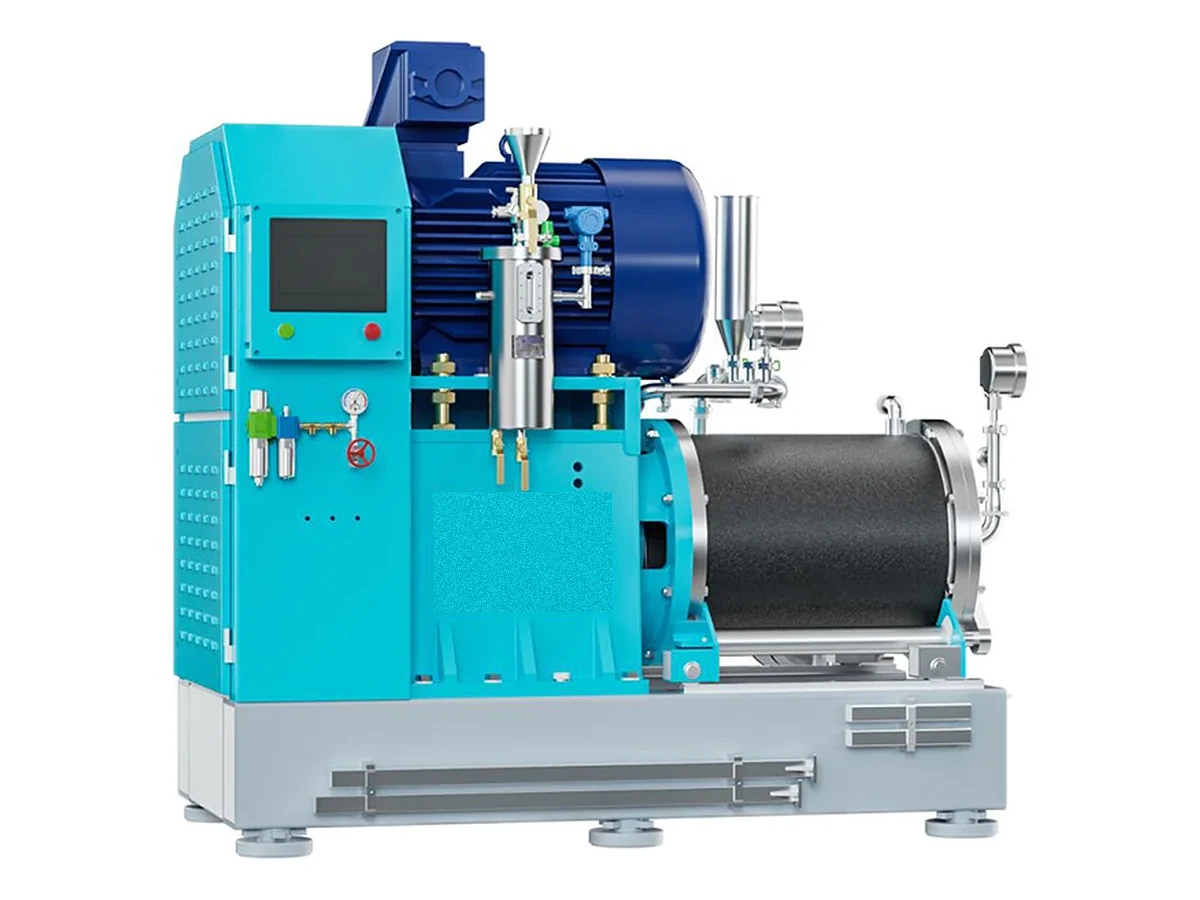
What we actually supply
A horizontal stirred media mill built around very small media — 0.05 to 0.3 mm — with a separator that will not blind at that media size, and enough cooling to keep the product from cooking before it grinds.
Five sub-configurations, picked by what your material demands rather than by chamber size:
Which sub-configuration
| Sub-series | Structure | Choose it when |
|---|---|---|
| PM-NP | Pin / rod-pin | General nano work; the default starting point — full PM-NP page |
| PM-NT | Turbine | You need a short residence time at high flow — full PM-NT page |
| PM-NX | Dual-power / centrifugal | Very high throughput with fine media, or media below 0.1 mm — full PM-NX page |
| PM-NC | All-ceramic wetted parts | Metal contamination must stay at ppm level — battery cathode, pharma |
| PM-NV | Vertical nano | Floor space is tight, or small batches with many changeovers |
What is a nano bead mill?
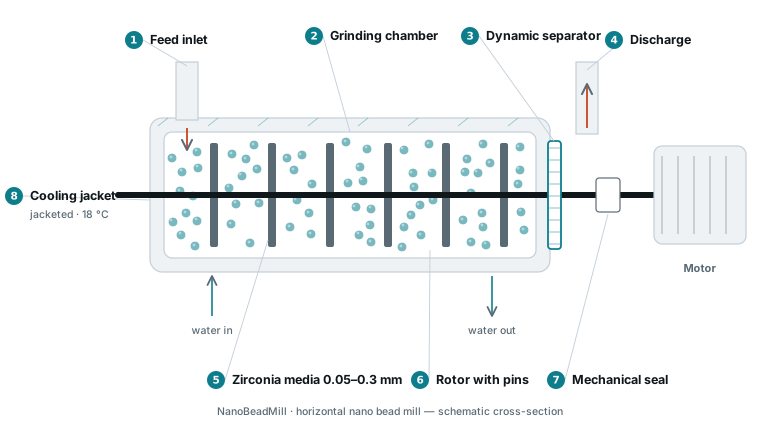
A nano bead mill is a stirred media mill in which the product is pumped through a grinding chamber filled with very small grinding media — typically 0.05 to 0.3 mm zirconia beads. A shaft fitted with discs or pins agitates the media at high tip speed, and particles are broken down by a combination of shear, impact and compression as they pass between the beads. The product then exits through a separator that retains the media while allowing the ground slurry to pass.
What makes it "nano" is not the machine size. It is three things together:
- Media size — sub-0.3 mm beads. Smaller beads mean more contact points per unit volume, which is what makes sub-100 nm achievable.
- Separation — at 0.1 mm media, a conventional screen will blind within minutes. Nano mills use gap separators or centrifugal separators.
- Energy density — nano grinding is energy-intensive. The chamber must be cooled aggressively, or you will cook the product before you grind it.
Key specifications — PM-N series
| Model | Chamber volume | Motor power | Media range | Throughput | Target fineness |
|---|---|---|---|---|---|
| PM-N5 | 5 L | 11 kW | 0.05 – 0.3 mm | 2 – 20 L/h | D90 < 100 nm |
| PM-N15 | 15 L | 22 kW | 0.05 – 0.3 mm | 10 – 60 L/h | D90 < 100 nm |
| PM-N30 | 30 L | 37 kW | 0.1 – 0.5 mm | 30 – 150 L/h | D90 < 100 nm |
| PM-N60 | 60 L | 55 kW | 0.1 – 0.5 mm | 80 – 300 L/h | D90 < 100 nm |
| PM-N150 | 150 L | 110 kW | 0.1 – 0.8 mm | 200 – 800 L/h | D90 < 100 nm |
Model figures are typical for this configuration — the binding specification comes with your quotation. Chamber volume, motor power and throughput are matched to your slurry: a figure that reads precise but has never been run on your product is worth less than an honest range. Tell us the product and we will fix the numbers in writing before you order.
Common to all models
- Wetted materials: SS316L / silicon carbide / zirconia / polyurethane
- Separator: gap separator or centrifugal
- Cooling: jacketed chamber, chilled water, 5 – 35 °C operating range
- Seal: double mechanical seal with barrier fluid
- Control: PLC + HMI, recipe storage, temperature and pressure interlocks
- Options: ATEX / explosion-proof configuration for solvent-based systems
Nano vs. sub-micron: when do you actually need nano?
This is the question we ask first, and the answer is often "you don't."
| Target | Typical media | Energy cost | Throughput | When you need it |
|---|---|---|---|---|
| D90 5 – 20 µm | 1.0 – 2.0 mm | Low | High | Fillers, extenders, matting agents |
| D90 1 – 5 µm | 0.6 – 1.0 mm | Medium | Medium-high | Most industrial coatings and inks |
| D90 200 nm – 1 µm | 0.3 – 0.5 mm | Medium-high | Medium | High-end automotive, inkjet, conductive additives |
| D90 < 100 nm | 0.1 – 0.2 mm | High | Lower | Nano dispersions, pharma suspensions, CNT/graphene |
Rule of thumb: target fineness is roughly media diameter ÷ 1,000 to ÷ 500. If you need 200 nm, start with 0.2 mm media. If you need 1 µm, 0.5–1.0 mm media will get you there faster and cheaper.
Going finer than your application requires costs you throughput, energy, media life and cooling capacity — and in pigments it can actually reduce colour strength. We will tell you if your target is finer than it needs to be. Most suppliers will not, because finer sells a bigger machine.
Media selection: the single biggest variable
| Media size | Realistic target | Typical application |
|---|---|---|
| 0.05 mm | D90 < 50 nm | Pharma nano suspensions, high-end electronics |
| 0.1 mm | D90 80 – 200 nm | Nano pigment dispersions, CNT and graphene |
| 0.2 mm | D90 200 – 400 nm | Inkjet, high-end automotive pigments |
| 0.3 mm | D90 300 – 600 nm | Conductive additives, premium coatings |
| 0.5 mm | D90 0.5 – 1 µm | General sub-micron coatings and inks |
Media wear matters more than most people expect. Worn or fractured beads add debris, change the effective size distribution, and can block a gap separator. We recommend yttria-stabilised zirconia, ≥ 95% ZrO₂ for nano work and can supply it with the machine.
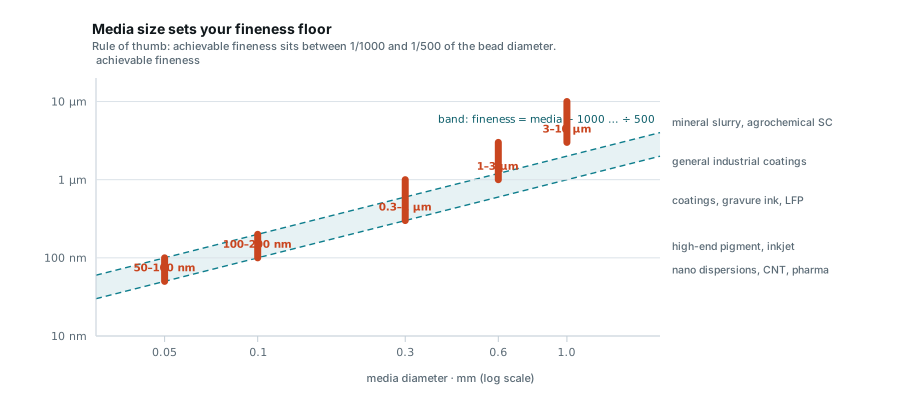
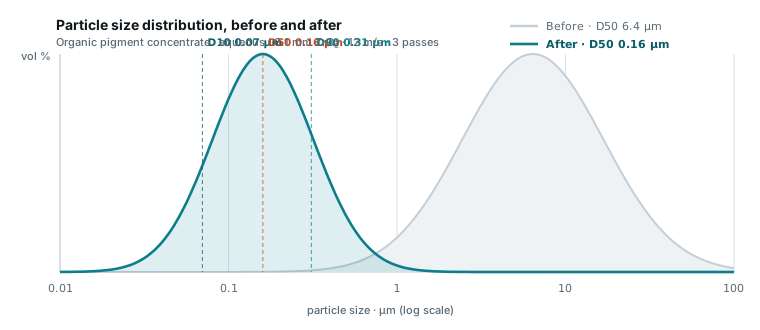
Both charts are generated from our own data model and are illustrative. Replace the PSD chart with a measured laser-diffraction report from your own trial once one exists.
Applications
- Pigment and coatings — organic pigments (phthalocyanine, azo), carbon black, transparent iron oxide
- Lithium battery — conductive additives (CNT, carbon black, graphene), cathode and anode slurry
- Ink — inkjet pigment concentrates requiring D90 < 200 nm
- Pharmaceutical — nano suspensions for poorly soluble APIs
- Agrochemical — high-concentration suspension formulations
What affects your final particle size?
Six variables, in rough order of impact:
- Media size and size distribution — the dominant variable. Narrower distribution gives a tighter result.
- Tip speed — higher tip speed means more energy per pass, but generates more heat. Typical range 8 – 15 m/s.
- Media fill rate — usually 70 – 85% of chamber volume. Too low and you lose contact points; too high and you lose cooling and generate heat.
- Residence time — controlled by feed rate and number of passes. Recirculation gives tighter distribution than single-pass.
- Temperature — viscosity drops as temperature rises, which changes the energy transfer. Tight temperature control means repeatable results.
- Formulation — dispersant type and loading often matters more than any machine parameter. If the formulation is wrong, no mill will save it.
FAQ
What sample volume do you need for a grinding test?
1 kg for a lab mill run, plus a little more if you want us to test two media sizes side by side.
Can you process solvent-based materials?
Yes. For flammable solvents we supply an ATEX / explosion-proof configuration.
What is the lead time?
Typically 8 – 14 weeks from order confirmation.
Do you supply grinding media?
Yes — yttria-stabilised zirconia beads from 0.05 mm upward, with a wear-rate data sheet.
See what your material can actually reach.
Send 1 kg. We run it on a PM-L laboratory mill, test two media sizes, and send you the full particle size distribution report. If we cannot hit your target, we will say so and tell you what will.