Lab and Pilot Bead Mill — Scale-Up Data You Can Trust
The point of a lab mill is not to make product. It is to tell you, before you commit to capacity, whether your target is reachable at all — and on what media.
What we actually supply
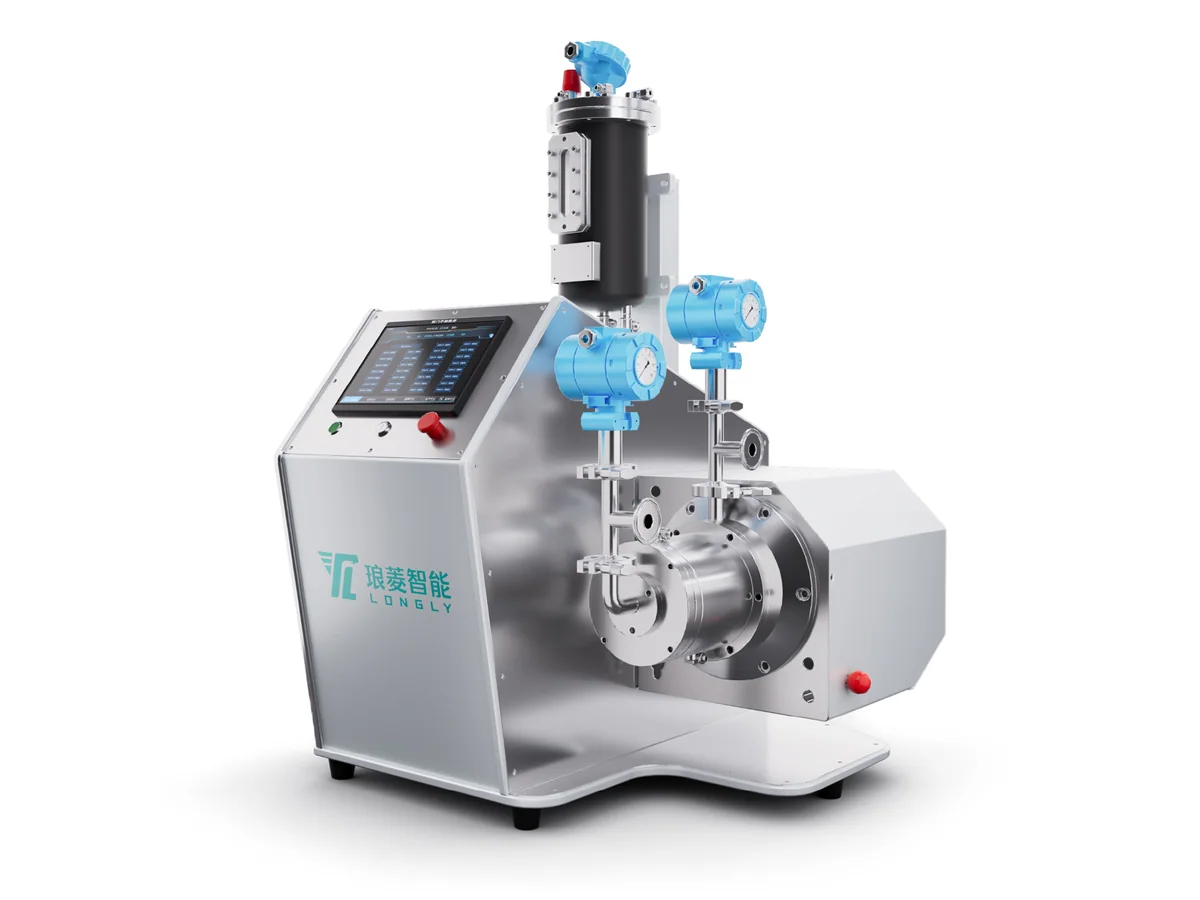
A small horizontal or vertical stirred media mill for R&D and pilot work — 0.5 to 10 L — built so that what you learn on it actually transfers to the production machine.
Two sizes, plus the test service that most people actually want:
Why lab results so often fail to scale
This is the fear behind almost every enquiry we get about lab mills, and it is a reasonable fear.
A 2 L trial says D90 180 nm. The production line says 400 nm, and nobody can explain why. Usually one of four things happened:
- Different media — the lab ran 0.1 mm, production was specified at 0.3 mm because it was cheaper.
- Different tip speed — the lab mill runs slower per unit of chamber, so the energy input per litre was never comparable.
- Different separator — a lab screen passes particles the production gap separator would retain, or the reverse.
- Different residence time — single-pass in the lab, recirculation in production, or a different number of passes.
None of these are mysterious. They are all specification choices. If you hold media, tip speed and separator geometry constant between scales, results transfer far more reliably than most people expect.
We will tell you if a trial result is unlikely to hold at scale — including when that means recommending a smaller production machine than the one you were about to buy.
What makes a lab result transferable
Four variables have to match between the lab mill and the production machine. If they do, scale-up is mostly arithmetic.
| Variable | Lab / pilot | Production | Why it must match |
|---|---|---|---|
| Media size & material | 0.05 – 1.0 mm | identical | Media size sets the achievable floor — the single largest variable |
| Tip speed | 8 – 15 m/s | identical | Energy per unit volume; changing it changes the result, not just the speed |
| Separator type & gap | gap or screen | same geometry | A different separator retains a different population of particles |
| Media fill rate | 70 – 85% | identical | Contact points and cooling both depend on it |
Figures are typical ranges for these configurations; the binding values are the ones in your quotation.
PM-L / PM-P series
| Model | Chamber volume | Motor power | Media range | Batch size | Purpose |
|---|---|---|---|---|---|
| PM-L0.5 | 0.5 L | 1.5 kW | 0.05 – 1.0 mm | 0.3 – 2 L | Formulation screening |
| PM-L2 | 2 L | 4 kW | 0.05 – 1.0 mm | 1 – 8 L | R&D and media selection |
| PM-P5 | 5 L | 11 kW | 0.1 – 1.0 mm | 5 – 30 L | Pilot runs, customer samples |
| PM-P10 | 10 L | 18.5 kW | 0.1 – 1.4 mm | 20 – 80 L | Pre-production validation |
Model figures are typical for this configuration — the binding specification comes with your quotation.
What you get from a free grinding test
Send 1 kg of your material. We run it on a PM-L laboratory mill under controlled conditions and send back:
- Particle size distribution chart — D10 / D50 / D90, measured, not estimated
- Two media sizes compared side by side — so you can see the sensitivity, not just one data point
- Recommended number of passes — and what happens to throughput at each one
- Our honest assessment — whether your target is achievable, and if not, what is
Turnaround: within 10 working days of receipt.
Choosing a size
| If you are… | Start with | Why |
|---|---|---|
| Screening formulations | PM-L0.5 or a basket mill | Speed matters more than precision at this stage |
| Selecting media and proving a target | PM-L2 | Enough volume for several runs on one batch |
| Making customer samples | PM-P5 | Realistic residence time, enough output to send out |
| Validating before a production order | PM-P10 | Same separator geometry as the machine you will buy |
FAQ
How much material do I need to send?
1 kg for a lab run, plus a little more if you want two media sizes tested side by side.
Will the lab result hold at production scale?
If media, tip speed and separator geometry are held constant — usually yes. We tell you in advance if any of those will change between the trial and the machine we would supply.
Can I buy the lab mill and skip the test?
Yes, and many customers do. But if you only need to answer one question, the test is cheaper and faster than buying equipment to answer it.
What is the lead time?
4 – 8 weeks for lab and pilot units — shorter than production machines because the configuration is standardised.
Send 1 kg. Find out whether your target is reachable before you buy anything.
This is the cheapest way to remove the risk of buying capacity that cannot reach your target. If it cannot be done, we will say so.